SM
Securities & Markets
Market conduct, broker-dealer obligations, disclosures, supervision and custody.
Three problems continue to shape how firms manage regulatory change.
First, meaning gets lost in translation. Regulatory publications pass through multiple teams, tools, and manual hand-offs before becoming requirements, policies, and controls. At every step, context can be lost, requirements can be mistranslated, and interpretation or analysis can diverge from the source.
Second, the regulatory chain is fragmented. There is often no durable connection from regulatory text to obligations, applicability, policies, and controls. Without that linkage, lineage is difficult to maintain, impact is harder to assess, and teams repeatedly reconstruct relationships that should already be known.
Third, compliance remains reactive. Without a connected regulatory chain, firms struggle to look forward—to simulate the impact of a proposed rule, identify affected obligations, policies, and controls, and understand what may need to change before the rule takes effect.
RegiSentinel addresses all three by turning regulatory information into a connected, traceable, and continuously analyzable regulatory intelligence layer.
First you understand what applies. Then you see what it means for your firm. Then you check whether the program lines up. Through every step, you can verify the answer, see why it was reached, and get a materially consistent conclusion from the same facts. Overview, Search, and Ask are how you look at that intelligence. Cases turn it into owned work.
How the model fits together
Each intelligence layer feeds the next. Trust runs through every conclusion. Below the layers, you view the work in Overview, Search, and Ask & Verify—and you act on it in Cases.
Through every layer
Before teams trust AI with regulatory work, they should be able to demand three things. Verifiability means you can open the numbered sources and check the conclusion against the primary regulatory text. Explainability means you can see why the system reached that view—which obligations, firm impacts, or program mappings matter, and on what basis. Reproducibility does not mean identical wording every time. It means that when you start from the same sources, effective dates, and underlying facts, you can reproduce a materially consistent regulatory conclusion.
Three connected layers
Obligation Intelligence turns regulatory publications into clear requirements. It interprets what the regulator is saying, extracts structured obligations and expectations from that text, and maps obligation lineage—how those obligations relate over time, including amendments, supersession, narrowing, expansion, and related guidance.
Enforcement outcomes link back to those same requirements through cited rules and shared themes—so a consent order is evidence of how a supervisor applied a duty you already track, not a separate list of new obligations.
Once the requirement is clear, Firm Impact Intelligence asks what that change means for your organization. It runs impact analysis across entities, businesses, products, and themes so you can separate what matters broadly in the market from what matters for your firm.
The layer looks for coverage and control gaps, assigns risk scores where exposure is elevated, and brings the highest-priority items forward—including Most Impacted areas and what Needs Attention first—so teams start with ordered work instead of an undifferentiated wall of alerts.
Compliance Intelligence works in both directions. Forward, it maps each regulatory obligation to the firm’s policies and controls (and, building toward, to evidence)—so you can see whether the program actually covers what the rule requires, where gaps sit, and how strong those relationships are.
It also closes the feedback loop. When a transaction fails, current tools already know which control was involved; Compliance Intelligence then traces that control back to the policies it implements, from those policies to the obligations they address, and from those obligations to the citations and regulatory source that started the chain. Together with obligation lineage, forward coverage and reverse trace read as one chain of reasoning.
How you view it · how you act
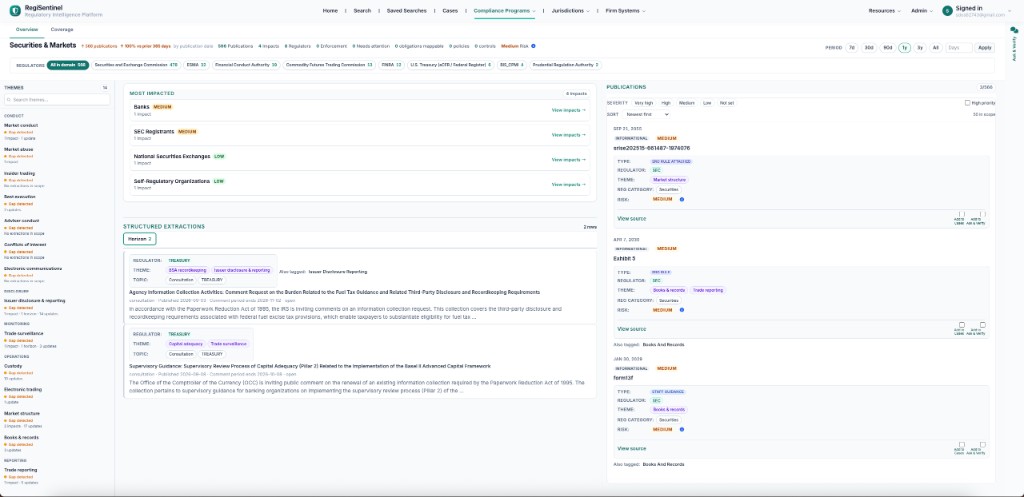
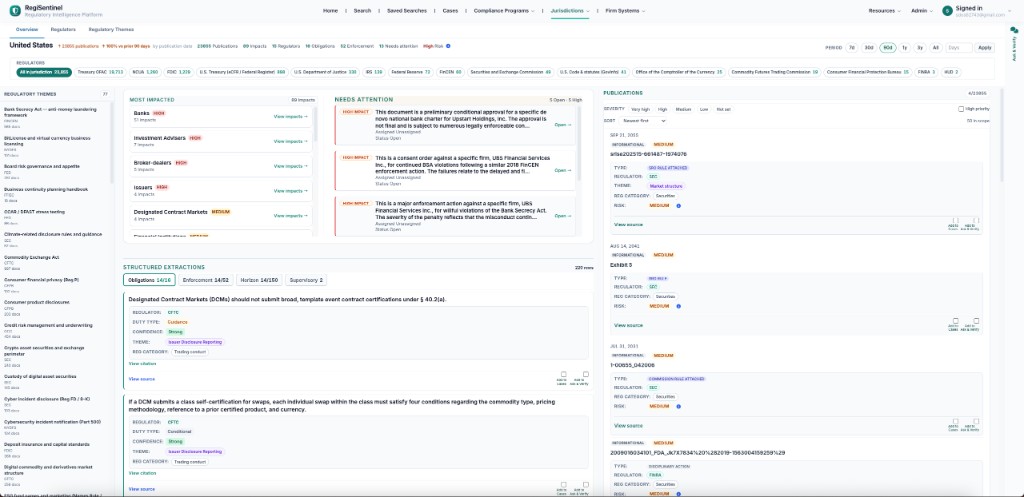
The intelligence layers are only useful if teams can see them in the way they already work. Overview is the main reading surface—inside a Compliance Program or a Jurisdiction—with a theme rail, Most Impacted / Needs Attention, Structured Extractions, and a publications feed. For how supervisors compare on one theme, open Regulator Map inside the program.
Search is for when the question is wider than one program. You get more than a document list: regulator and theme trends, clustering around your query, and a landscape view before you open individual sources. From results you can add material into Ask & Verify, where plain-language questions return answers with numbered citations you can open and check against the primary text.
Together, Overview, Search, and Ask & Verify are how Regulatory Intelligence is viewed.
Cases turn conclusions into owned work. When something from Needs Attention, Search, or Ask requires follow-up, a case carries an owner, status, due date, and linked regulatory sources so context does not get lost between Monday morning and the next exam.
Teams work from a shared queue—My Cases and All Cases—so supervisors can see what is open, blocked, or in review across the desk. Each case keeps a journal of decisions and updates, plus attachments and evidence tied to the publications and obligations that triggered the work.
That record is what makes Cases exam-ready: not only what the rule required, but what the institution did, who owned it, and why the response was reasonable at the time—alongside the source trail from verifiability and explainability.
Looking ahead Building toward regulatory-change simulation—seeing impact before a rule lands.
Start where the work already is. Open a Compliance Program or a Jurisdiction Overview (regulators on top, themes on the left, Most Impacted / Needs Attention / Structured Extractions in the center, publications on the right). Or begin in Search, Ask & Verify, or Cases.
Overview is the main reading surface once you are in a program or jurisdiction. Regulator Map (inside a Compliance Program) shows how supervisors treat a shared theme—By theme or All regulators. Search, Ask & Verify, and Cases are other doors in—not a sequence after Overview.
Each Compliance Program combines monitoring, structured extractions, Regulator Map, source-linked Q&A, and case workflow.
Market conduct, broker-dealer obligations, disclosures, supervision and custody.
CDD, transaction monitoring, beneficial ownership, sanctions, SAR and program governance.
Capital, liquidity, governance, supervisory expectations and operational risk.
UDAAP, fair lending, retail product rules and exam priorities.
Money transmission, remittance rules, travel rule and licensing.
VASP obligations, stablecoins, custody and digital asset structure.
TPRM, cyber resilience, business continuity and third-party oversight.
Model risk, AI in financial services and emerging supervisory guidance.
GLBA, cyber rules, breach notification and data protection.
Climate disclosures, sustainability rules and ESG supervision.
Same layout language in both entry points: regulator strip, theme rail, center intelligence, and a publications feed.
RegiSentinel stores your policies and controls, maps them to obligations, and gives teams workflow tools for regulatory and compliance work—growing toward fuller GRC capabilities for those same workflows. Use it as your home for the firm library, or keep your existing stack and connect through APIs and connectors to internal systems and third-party vendors (GRC, surveillance, TMS, and more).
Hold the firm library in RegiSentinel—policies, controls, and mappings against program obligations—so you can run coverage and reviews without depending on another system.
Move from gap to owned work: reviews, Cases, and follow-up built for regulatory and compliance teams, with deeper GRC-style capability for those workflows as the product expands.
Sync with the tools you already run—internal firm systems and third-party vendors—so library updates, alerts, and evidence stay linked to the obligations behind them.
When a publication updates, see which obligations changed, follow the path from source through policy and control, and get a clear impact summary you can turn into a Case.
Compare the new publication with the one it replaces. See which obligations are new, updated, or gone—and read the before-and-after text so the difference is clear.
Follow the chain from the regulatory source to the obligation, then to your policy and control. The path touched by this change is highlighted so you can open any step for detail.
Get a short scorecard of what is affected—policies, controls with gaps, programs in scope, and open Cases—so you know where to act next.
At each handoff today, teams risk interpretation error, information loss, and delay—because so much of the chain is still manual. RegiSentinel applies intelligence through the chain while preserving source evidence you can open and check.
Rules, guidance, enforcement, and supervisory updates enter the corpus.
What changed—and what the regulator expects—in structured form.
Requirements tied to source text; enforcement linked via cited rules and themes.
Horizon, supervisory signals, and themes that cluster around your scope.
Who is affected and how severely—Most Impacted and Needs Attention.
Turn what changed into clear, cited answers for your program—before you update policies and controls.
Store and map policies and controls in Firm Systems—standalone, or synced via APIs and connectors to systems you already run.
Cases with owners, status, evidence, and an exam-ready trail.
Every Compliance Program includes Regulatory Pulse—a quarterly summary of what changed in that program: new publications by regulator, themes gaining traction, enforcement trends, and the business types most affected. Open it from your program card on workbench home.
Article
Podcast
Press release
Platform announcement covering Obligation Intelligence, Firm Impact Intelligence, Compliance Intelligence, and evidence throughout.
Business Insider Markets →Today RegiSentinel carries regulation through to Cases. Looking ahead, the same thread closes the loop with the systems you already run—and lets you simulate change before it lands.
Looking ahead
A rule, guidance, or supervisory update enters the picture.
What the firm must do—extracted and tied back to source text.
How the institution interprets and commits to that obligation.
The check or process that keeps the policy real day to day.
Evidence from operations—what actually happened in the firm.
Findings from GRC, surveillance, or TMS (where connected) feed back into the loop— so the next change starts from what you already learned.
Plus simulation
See the impact of a proposed or upcoming rule across obligations, policies, and controls before it lands—so you can plan, not just react.
Context
How RegiSentinel delivers Regulatory Intelligence—three connected layers, evidence throughout, and Cases when work needs an owner.
Book a walkthrough, ask about a pilot, or bring questions from your compliance or legal team.
Schedule a callTrust
We ingest material from supervisory agencies and standards bodies worldwide. What appears in your workspace reflects the Compliance Programs your organization licenses.
FAQ
Straight answers for teams evaluating regulatory intelligence—not another alert feed.
After the alert: understand obligations, assess firm impact, Ask & Verify with citations, and manage follow-up in Cases—inside Compliance Programs scoped to your disciplines.
The catalog is the foundation. On top, RegiSentinel adds three connected layers—Obligation, Firm Impact, and Compliance Intelligence—with structured extractions, Regulator Map, cited Ask & Verify, and Cases so teams move from reading to owned work.
No. It supports research and regulatory operations. Your firm's policies, procedures, and counsel remain the authority on what you must do.
See our official sources map for the supervisory families we draw from. Your live corpus is configured when your organization is onboarded.
Get started
Evaluation includes full workbench access. We typically respond within one business day. Already have an account? Sign in.